Visibility, Variability & Vibrancy: A New Framework for an AI Disrupted World
We are currently living through a "Cambrian Explosion" of media formats.
Generative Engine Optimisation (GEO) dictates how AI reads us. Social algorithms demand specific engagement patterns. And a global audience suffers from what the strategists call "the sea of sameness"; brands are all sounding alike, are all following the same playbook, and are all vanishing into background noise.
If you are still planning a 2026 strategy with a 2019 playbook, you are not just falling behind. You are becoming invisible in the places your customers actually search.
Here is what has changed since you last looked up:
62% of users now use AI applications for Q&A, making AI dialogue platforms the primary sources for decision-making.
50% of search traffic could be AI-driven by 2028.
Yet most marketing plans still optimise exclusively for Google rankings and call it a day.
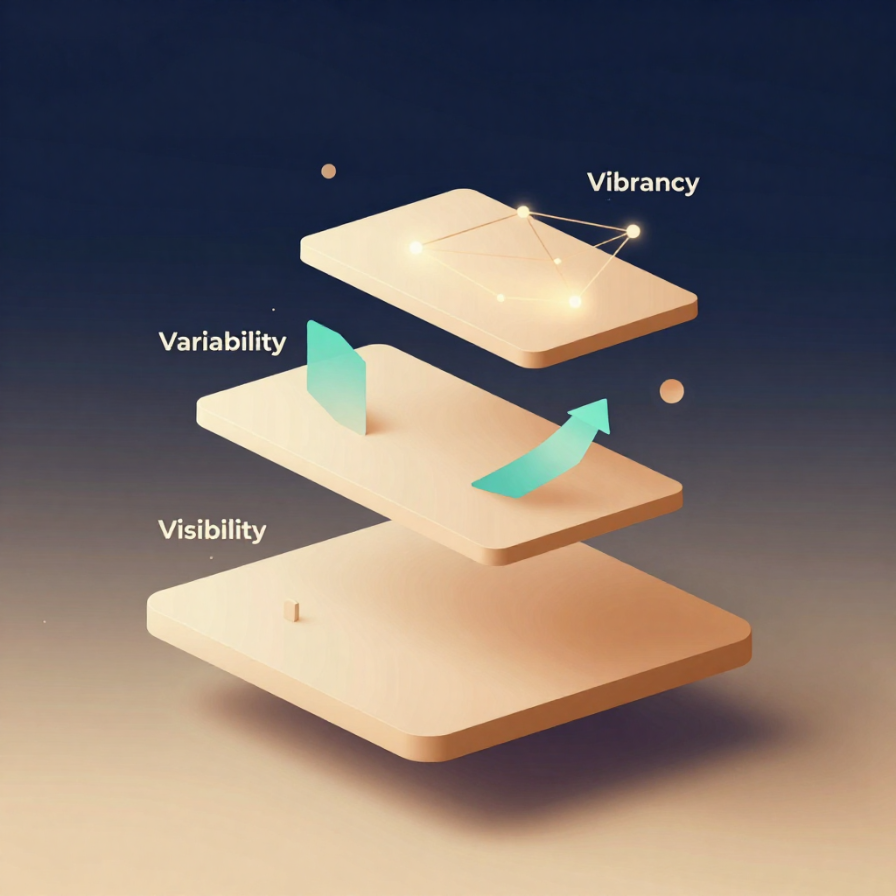
Meanwhile, Oxford University and UM analysed 10,000+ brands and 5 million data points across 17 countries and found that growth comes from three distinct factors: Visibility (64%), Variability (25%), and Vibrancy (11%).
But how do these connect to the way we have always planned through Paid, Owned, and Earned media?
Let me show you.
The Foundation: Paid, Owned & Earned (The "How")
Before we talk outcomes, we need infrastructure. Your media mix is the engine:
| Channel | Definition | Examples |
|---|---|---|
| Paid Media | You pay for reach | Ads, sponsorships, paid influencers |
| Owned Media | You control the platform | Website, blog, email, social profiles |
| Earned Media | Others talk about you | PR, reviews, UGC, creator content |
This framework answers how you reach people.
But it does not answer what you achieve once you get there. That is where the 3 Vs come in.
The Outcomes: Visibility, Variability & Vibrancy (The "What")
Bucket 1: Visibility (64%) — The Non-Negotiable Foundation
Visibility is still dominant. If people cannot find you, nothing else matters. But where they find you has shifted.
The 2026 Reality:
Daily AI search users in the US rose from 14% (Feb 2025) to 29.2% (Aug 2025).
Social search is eating Google's lunch, especially Gen Z starting product searches on TikTok.
Reddit is the top website cited by AI engines (40.1%).
How Paid/Owned/Earned deliver Visibility:
Paid: Search ads, social ads, sponsorships that put you in front of active seekers.
Owned: SEO optimised content, website structure, GEO-ready pages with clear definitions.
Earned: PR mentions, backlinks, and citations that signal authority to AI.
The shift: 73% of marketers are prioritising short-form video, and 47% are prioritising UGC. Why? Because that is where discovery happens now.
Bucket 2: Variability (25%) — Escaping the Sea of Sameness
This is the bucket most brands ignore entirely. Variability is what makes you different. In a world drowning in the "sea of sameness," differentiation is your only lifeline.
Why variability matters more in 2026:
AI has a "normative mechanic." It tends toward the mean, toward safe answers, toward what is statistically likely. If you feed it generic content, you get a generic representation.
How Paid/Owned/Earned create Variability:
Paid: Fund the risky creative. Pay for placements that showcase your unique POV, not just your product specs.
Owned: This is your primary home for differentiation. Your blog, your founder's voice, your unconventional case studies.
Earned: The most powerful validator. When creators and customers describe what makes you different, it lands harder than anything you say yourself.
The GEO connection:
AI systems favour content with:
Semantic depth: complete knowledge architecture, not thin pages.
Information credibility: data-backed claims, authoritative sources.
Contextual relevance: content that maps to user intent across the journey.
Influencer marketing as variability:
This is where creators become strategic assets, not for reach, but for difference.
Audiences now trust individual experts the way previous generations followed news anchors. And critically, AI is more influenced by what others say about a brand than what the brand says about itself.
Creator content trains the models behind the scenes. If you are not in the creator conversation, you are not in the AI's understanding of your category.
The trend:
The shift is from "influencer as reach" to "creator as counsel."
Bucket 3: Vibrancy (11%) — The Community Multiplier
Vibrancy is the smallest contributor numerically, but it acts as a force multiplier on the other two. It is engagement, conversation, community. These are the signals that tell platforms (and AI) that people actually care.
Where vibrancy lives in 2026:
Discord, Substack, Medium: peripheral spaces where communities gather.
Live and peer-to-peer environments: social commerce and community-driven retail.
Authentic UGC: 47% of marketers are prioritising it.
How Paid/Owned/Earned fuel Vibrancy:
Paid: Spark conversation. Use ads to invite dialogue, not just broadcast messages.
Owned: Host the community. Your platforms become gathering places.
Earned: The purest form. When people talk about you unprompted, that is vibrancy in action.
The AI angle:
AI citation patterns show that forums and community conversations directly shape search results. Your brand's vibrancy in these spaces becomes training data for how AI understands your relevance.
The convergence:
In 2026, social media marketing, customer care, and commerce strategies will converge into seamless experiences. Two-thirds of social marketers already collaborate closely with care and commerce teams.
Putting It Together: The Combined Framework
| Paid Media | Owned Media | Earned Media | |
|---|---|---|---|
| Visibility (64%) | Search/social ads, sponsorships | SEO/GEO content, website | PR, backlinks, AI citations |
| Variability (25%) | Differentiated creative campaigns | Unique POV, founder content, blog | Creator partnerships, reviews |
| Vibrancy (11%) | Conversation starting ads | Community platforms, comments | UGC, forums, word of mouth |
The bottom line:
If your plan only addresses Visibility, you are leaving 36% of potential growth on the table. And you are ceding your differentiation to competitors who understand how AI actually decides what to recommend.
The brands that win in 2026 will not just be seen. They will be remembered. And they will be talked about.
Download the FREE 3-Bucket Strategy Canvas (PDF) | Editable version (Google Doc)
Map your 2026 initiatives across Visibility, Variability, and Vibrancy, with real-world examples to inspire you.