How Can Small Businesses Reduce Digital Marketing Costs in 2026?
If you are running a business in 2026, you have probably noticed that your digital advertising costs are climbing while your results feel flat. You are not imagining it. The economics of digital marketing have changed, and the old playbook of "spend more to grow more" no longer works.
Feedvisor's 2026 Brand Survey, which drew on insights from more than 1,000 brand and e-commerce leaders, found that nearly eight in ten brands saw their cost per click rise year over year. One third experienced increases above 10%. Across consumer goods specifically, CPCs are up roughly 12% as more brands compete for limited ad inventory. Even retargeting, once a reliable performer, has seen CPMs jump 18% in early 2026.
At the same time, Forrester predicts marketers will cut display advertising budgets by 30% this year as consumers increasingly move away from the open web. The shift is driven by audiences migrating to connected TV, social video, and AI-generated search summaries that bypass traditional display placements altogether. Global ad budgets are expected to be down 31% overall, with more than half of large multinationals freezing spend for six months or longer.
The question has shifted from "How much should we spend?" to "How can we ensure that our expenditures are effective?"
The Hard Numbers You Need to Know
Understanding the return on investment for different channels is the first step toward spending smarter.
For every dollar spent on Google Ads, the average business sees about $2 in return. For paid social, that figure is closer to $1.75. Those are not terrible numbers, but they leave very little margin for error once you account for rising media costs, creative production, and the time required to manage campaigns.
Compare that to channels you own.
Email marketing consistently returns between $36 and $42 for every dollar spent. That is a 3,600% to 4,200% return, a figure that appears consistently across Litmus, EmailToolTester, Omnisend, and other major industry studies, making it the most defensible benchmark for planning and forecasting. Verified Email's ROI Statistics report provides a comprehensive breakdown of this data.
SEO delivers approximately 748% ROI for B2B businesses over three years, or roughly $7.48 for every dollar invested, according to First Page Sage.
Organic search converts at 14.6%, compared to paid search's conversion rate of 10%, according to an analysis by Click-Vision.
The gap between these figures is not a rounding error. It is a strategic chasm.
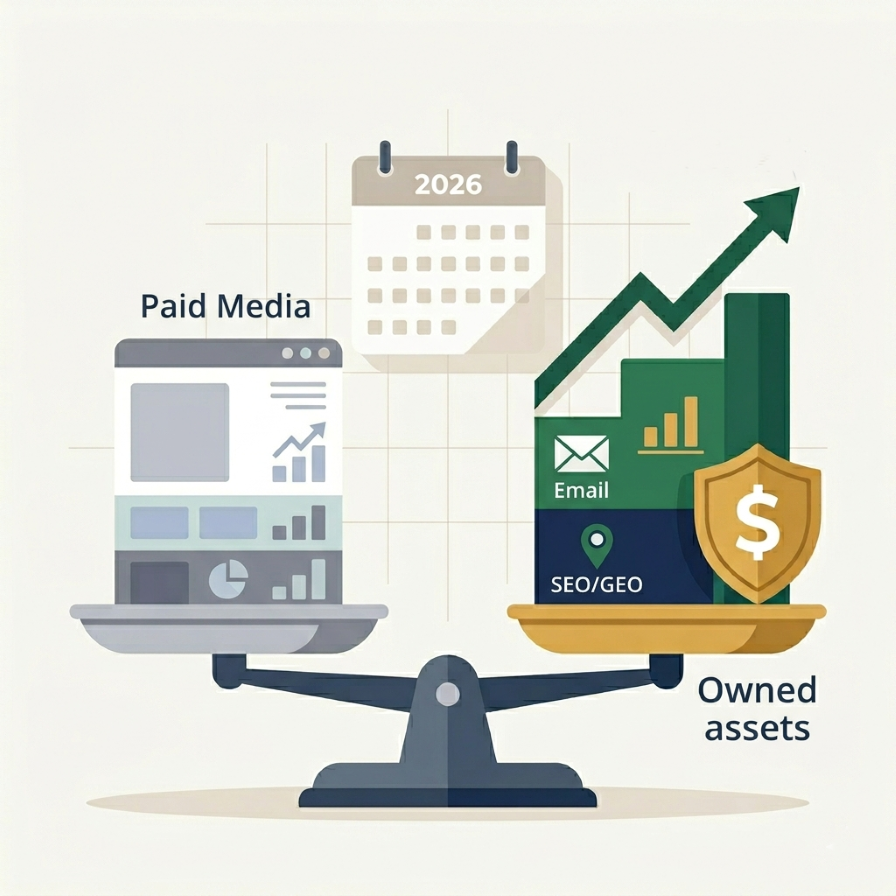
What makes this gap so significant is the difference in ownership. When you invest in Google Ads, you are renting access to an audience. The moment you stop paying, the traffic stops. When you invest in email and SEO, you are building assets you own. The list is yours. The content is yours. The relationship is yours.
Digital ad spend continues to grow globally, but the composition of that spend is shifting. First-party data strategies are gaining priority as regulatory changes and platform automation reshape how campaigns can be executed. The businesses that will thrive in this environment are not necessarily the ones spending the most. They are the ones spending the smartest.
Why Paid Media Is Getting Harder
This is not a temporary dip. The cost increases are structural.
Media Inflation Across Platforms
Media inflation across Google, Meta and LinkedIn has been trending upward for five years. More businesses are competing for the same finite ad inventory. Platform automation, including Google's shift toward broad match and Performance Max, requires larger and more stable budgets to function effectively. When budgets are constrained or frequently changed, campaigns underperform.
The Attribution Problem
There is also a measurement problem. Only 36% of marketers say they can accurately measure ROI, and 47% struggle to measure ROI across multiple channels because attribution is genuinely hard. This means most ROI benchmarks are based on partial data.
Email's $36 to $42 return is well-documented because the causal chain is clear — you send an email, someone clicks, someone buys.
SEO's ROI is harder to calculate because a blog post written in 2023 might drive a sale in 2026 via a customer who first discovered you organically, then converted through retargeting.
Many businesses still rely on last-click attribution, favouring whatever channel appears to win in GA4 or their CRM. This approach typically leads to:
Underinvestment in upper funnel activity
Overreliance on branded search and remarketing
Artificially inflated performance expectations
Paid media still has a role. It provides immediate visibility. It enables fast testing. It can drive volume when needed. But in 2026, it should be viewed as a tactical lever rather than the foundation of your marketing strategy.
Where to Shift Your Budget
The logical response to rising paid media costs is to redirect resources toward channels that deliver higher, more predictable returns.
Email and SMS: The ROI Powerhouse
Email operates outside the auction system, which drives up paid media costs. You are not bidding against competitors. You are communicating directly with people who have already shown interest in your business.
Klaviyo's 2026 benchmarks, based on data from over 183,000 brands, show that:
Automated email flows generated nearly 41% of total email revenue from just 5.3% of total email sends
Average revenue per recipient is nearly 18 times higher for automated flows than standard campaigns
Behaviour-triggered messages consistently outperform generic batch campaigns. SMS delivers similarly strong results, particularly for time-sensitive offers and reminders.
The consensus across multiple industry studies is clear: email marketing delivers $36 to $42 for every dollar spent, with top performers seeing significantly higher returns. Verified Email's comprehensive ROI report aggregates this data from across the industry.
SEO and Content Marketing: The Compounding Asset
SEO takes time, typically four to six months before meaningful results appear. But unlike paid ads, which stop delivering the moment you pause spending, SEO compounds. Content created today can drive traffic and conversions for years.
The data support this long-term approach:
B2B SEO delivers an average 748% ROI over three years (First Page Sage)
Content marketing generates three times more leads than traditional outbound marketing while costing 62% less (DemandSage)
Organic search converts at 14.6% versus paid search's 10% (Click-Vision)
For businesses willing to invest for the long term, this is one of the most capital-efficient growth strategies available.
First-Party Data: Your Competitive Moat
With third-party cookies disappearing and platform algorithms becoming less transparent, first-party data is now the most valuable asset in digital marketing. An email list you own is worth far more than a retargeting audience you rent. Businesses building robust first-party data strategies today will have a structural advantage for years to come.
Advertisers across North America and Europe are already recognising this shift. First-party data strategies are gaining priority amid regulatory changes, and retail media networks are emerging as serious alternatives to traditional platform advertising.
The Marketing Efficiency Audit: A Four-Step Framework
Knowing where to shift is one thing. Actually doing it requires a clear, honest assessment of your current performance. Here is a simple framework you can apply.
Step One: Calculate Your True Cost Per Acquisition
Most businesses calculate the acquisition cost by dividing media spend by new customers. This is a start, but it is rarely complete. A full CPA calculation should include:
Creative development costs
Agency or freelancer fees
Martech subscriptions
Internal staff time
You cannot make informed allocation decisions until you know what the acquisition actually costs.
Step Two: Audit Channel Performance Separately
Do not rely on blended averages. Break down performance by:
Channel
Audience type
Device
A channel that produces cheap leads with a poor close rate may be far less valuable than one producing expensive leads that reliably convert.
Pay particular attention to mid-funnel drop-offs. The biggest opportunities are often hidden in conversion paths that look efficient on the surface but leak value at key transition points.
Step Three: Compare Paid Versus Owned Efficiency
For each dollar spent on paid media, calculate what the equivalent investment in email or SEO could deliver. This exercise is not about eliminating paid spend. It is about identifying the point at which marginal returns from paid channels fall below the returns available from owned channels.
A useful benchmark: aim for a lifetime value to CPA ratio of at least three to one for sustainable growth. If you are consistently below that threshold, rebalancing is necessary.
Step Four: Set Clear Reallocation Targets
Based on your audit, set specific targets. For example:
"Reduce display advertising spend by 25% over the next six months and redirect those funds toward email automation and SEO content development."
Make the transition gradual:
Test assumptions with small shifts first
Measure the impact
Adjust based on real data, not guesswork
What This Means for Your Business
The businesses that succeed in 2026 will not necessarily be those with the largest marketing budgets. They will be those who understand marketing efficiency is the new competitive advantage.
This starts with questioning long-held assumptions:
Are you running campaigns because they work or because you have always run them?
Are you measuring what matters or what is easiest to measure?
Are you building assets you own or simply renting access to someone else's audience?
A marketing efficiency audit, whether conducted internally or with external support, provides clear answers. It surfaces waste. It identifies opportunities. And it offers a roadmap for reallocating investment toward channels that deliver sustainable returns.
In a year when every dollar counts, that clarity is essential.
Key Takeaways
Paid media costs are rising structurally, not temporarily. Eight in ten brands report year-over-year CPC increases, with one third seeing increases above 10%. This is the new baseline.
Display advertising budgets are being cut by 30% in 2026 as audiences migrate to CTV, social video, and AI-powered search interfaces (Forrester).
Email marketing returns $36 to $42 per dollar spent, compared to roughly $2 for Google Ads and $1.75 for paid social. This gap is consistent across multiple large-scale industry studies (Verified Email).
SEO delivers 748% ROI for B2B businesses over three years, while organic search converts at 14.6% versus paid search's 10% (First Page Sage, Click-Vision).
Automated email flows generate 41% of email revenue from just 5.3% of sends, with revenue per recipient nearly 18 times higher than standard campaigns (Klaviyo).
Content marketing generates three times more leads than traditional outbound marketing while costing 62% less (DemandSage).
Only 36% of marketers can accurately measure ROI, making proper attribution and auditing essential for smart budget allocation.
First-party data is your most valuable marketing asset. Building an owned audience provides insulation from rising ad costs and platform changes.
A structured marketing efficiency audit reveals waste and identifies where to reallocate budget for maximum return.
The winning question in 2026 is not "how much can we spend?" It is "how well are we spending what we have?"