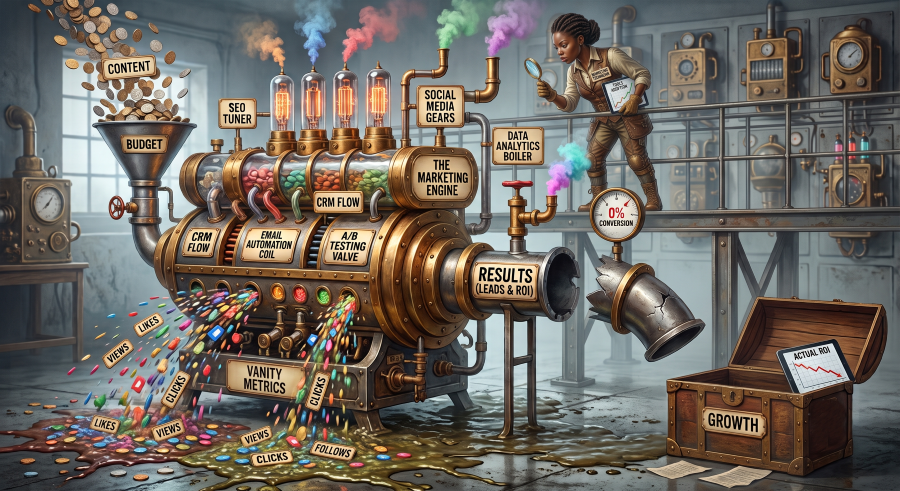
Here is a pattern I keep seeing. A business invests time and money into smarter marketing tools. They follow the setup guides. They run the campaigns. Six weeks later, the results are either flat or worse than before.
The tools get the blame. But nine times out of ten, the tools are not the problem.
If you have done everything right and the results are still flat, the problem probably is not the platform. The question worth asking is, 'What exactly are you feeding it?’
Businesses are adopting smarter tools faster than ever, but the tools are only as useful as what you put into them. If your data is messy, your systems are not talking to each other, or you are measuring the wrong things, then the smartest tool in the world will happily optimise you towards the wrong results.
This post is about fixing that. Before you set up another automation, add another platform, or spend another pound on a campaign, run through this audit first.
(If you want the bigger picture on why automated tools and agents matter for your business, I covered that in The Agentic AI Guide and showed practical examples in How Small Businesses Can Actually Use AI Agents. This post is the piece that sits between the two: what needs to be working before any of it delivers.)
Key Takeaways
Your tools perform based on the quality of information you give them. Better inputs lead to better results.
Most small businesses have the same four problem areas: broken tracking, disconnected systems, the wrong success measures, and too many tools doing the same job.
You do not need to overhaul everything. Fix one area at a time, starting with your conversion tracking.
A simple monthly check-in on your tech stack will save you more time and money than any new subscription will.
The Real Problem: You Are Feeding Your Tools Junk
Here is the uncomfortable truth. When a business tells me their email automation is not working, or their ad spend is not converting, or their customer reports do not make sense, the technology is rarely the issue. What is usually broken is the information flowing into it.
Think of it like a sat nav. You can have the most sophisticated navigation system in the world, but if you type in the wrong destination, it will confidently guide you somewhere you did not want to go. Efficiently. Every single time.
Marketing tools work the same way. When your tracking is broken, your systems are siloed, and your success measures are vague, you are not just getting poor results. You are getting poor results on repeat, faster, at scale.
The good news is that the fix is usually less complicated than people expect. It just requires being honest about where the gaps are.
The Four-Area Audit: Where Things Usually Go Wrong
Your Conversion Tracking Is Broken (or Measuring the Wrong Thing)
This is the most common issue I see, and the most damaging. Businesses set up tracking once, assume it is working, and never check it again.
What tends to go wrong: you track a form submission as a "conversion" but never check whether those submissions are turning into actual customers. Your ad platform sees hundreds of "conversions" and optimises accordingly. But half of them are tyre-kickers, spam, or people who never reply to a follow-up.
The result? You spend more on what looks good on paper and less on what actually brings in revenue.
The check: Look at your last three months of conversions. Pick ten at random. What happened to them? Did they become customers? If you cannot answer that question, your tracking needs attention before you spend another penny on campaigns.
2. Your Systems Are Not Talking to Each Other
Most small businesses end up with a collection of tools, each added to solve a specific problem. A CRM for contacts. A separate email platform. An e-commerce system. A booking tool. An analytics dashboard.
Each one holds a piece of the picture. None of them holds the full picture. And because they are not connected, you end up making decisions based on partial information without realising it.
A business I worked with recently had its customer purchase data in one place and its email engagement data in another. They thought their least-engaged customers were lapsed. When we connected the data, we discovered those "lapsed" customers were actually their highest-spending repeat buyers. They just preferred to shop directly rather than click through emails. The business had nearly written them off entirely.
The check: List every tool your business uses. Draw a line between each one where data flows automatically. Any tool sitting on its own, with no connection to the others, is a blind spot in your decision-making.
3. You Are Measuring Effort Instead of Outcomes
This one is subtle, but it matters. It is easy to track what is visible: emails sent, posts published, ads running, and pages live. These feel productive. They are not the same as results.
The businesses that get the most from their marketing are measuring what happens after the click, not just whether the click happened. Did the person who downloaded your guide ever become a client? Did the customer who clicked your ad buy once, or three times? Did your event drive enquiries that actually converted?
When your success measures stop at activity, your tools optimise for activity too. You end up with more traffic, more opens, more clicks, and no meaningful change in revenue.
The check: For each marketing channel you run, ask, 'What is the last step we track, and what happens after that?’ If you cannot trace a direct line from your marketing activity to either revenue or a meaningful business outcome, you are missing a step.
4. You Have Tool Overlap and Data Duplication
More tools do not mean more clarity. In most cases, they mean more noise.
If you have two platforms tracking website behaviour, you will get two different numbers and spend your time debating which one to believe instead of acting on either. If your customer list exists in three places that are only manually synced, your personalisation will be inconsistent, your reporting will be inaccurate, and your automations will send things to people they should not.
The check: Look for any data that lives in more than one place and is not automatically kept in sync. If you are manually exporting and importing anything regularly, that is a process that needs fixing before you add anything new.
What Good Actually Looks Like
You do not need a perfect tech stack. You need one that is honest.
Good looks like this: when a customer buys from you, that information flows into the systems that need to know about it without anyone having to copy it manually. When a campaign runs, you can tell within a reasonable timeframe whether it is bringing in customers or just traffic. When you check your reports, the numbers tell a consistent story across platforms.
It does not have to be complicated. I have worked with businesses running beautifully on four tools that are well-connected. I have also worked with businesses drowning in twelve tools that are all telling a different story.
The goal is clarity, not sophistication.
Where to Start
If this has made you want to audit everything at once, resist that urge. Pick one area and fix it properly before moving on.
If your tracking is broken, start there. Everything else depends on it.
If your systems are disconnected, map what you have first. You may find the connections already exist and just need to be switched on.
If your measures are fuzzy, spend an hour writing down what a successful customer journey actually looks like from first contact to repeat purchase. Then work backwards to see whether you are measuring any of those steps.
If you have a tool overlap, do not cancel anything yet. Spend a month working out which platform you actually trust, then consolidate.
One area. Four weeks. Then move to the next.
A Monthly Check-In Worth Adding to Your Calendar
Once your foundations are in order, a simple monthly habit will keep things clean:
Are my key conversion events still tracking correctly?
Is there any data that has stopped flowing between systems?
Are the results I am seeing this month consistent with what I know to be true about my business?
Has anything changed (a new tool, a website update, a campaign) that might have broken a connection?
Twenty minutes a month will catch most problems before they quietly cost you thousands.
The tools available to small businesses right now are genuinely impressive. But impressive tools and strong results are not the same thing. The businesses seeing real returns are not necessarily the ones with the most advanced setups. They are the ones who built clean foundations before they scaled.
Get the basics right first. Everything else becomes easier.
Want help auditing your current setup and identifying where the gaps are? Let's talk.